
Pharmaceutical manufacturing: how to overcome the challenges towards Pharma 4.0
Although further optimizing your pharmaceutical manufacturing processes is crucial to strengthen your competitive edge, it also comes with certain challenges. In this third and final article of our Pharma 4.0 series, we explore how to tackle these obstacles.
A quick recap. In the first article of this series, we discussed the building blocks of tomorrow’s pharmaceutical manufacturing. In the second, we showed how the machines we engineer and build are turning the promises of Pharma 4.0 into tangible benefits.
In this final article, we discuss the challenges ahead. Because indeed, benefits often come with obstacles. Reaching the highest standard in pharmaceutical manufacturing requires investment and calls for changes not only in your machinery but also in your organizational structure.
These are the 6 challenges we are seeing in the field and how we, as a machine developer, can help you overcome them.
1. Compliance
Pharma 4.0 technologies leverage advanced systems and software. Meeting legal requirements is a significant challenge for pharmaceutical companies.
However, new technologies for pharmaceutical manufacturing are not just the source of compliance questions; they can also be part of the answer.
An example of this can be found in the article Automated loading system for a lyophilizer: an answer to the stricter GMP. Automation and new technologies can actively help you comply with increasingly stringent rules.
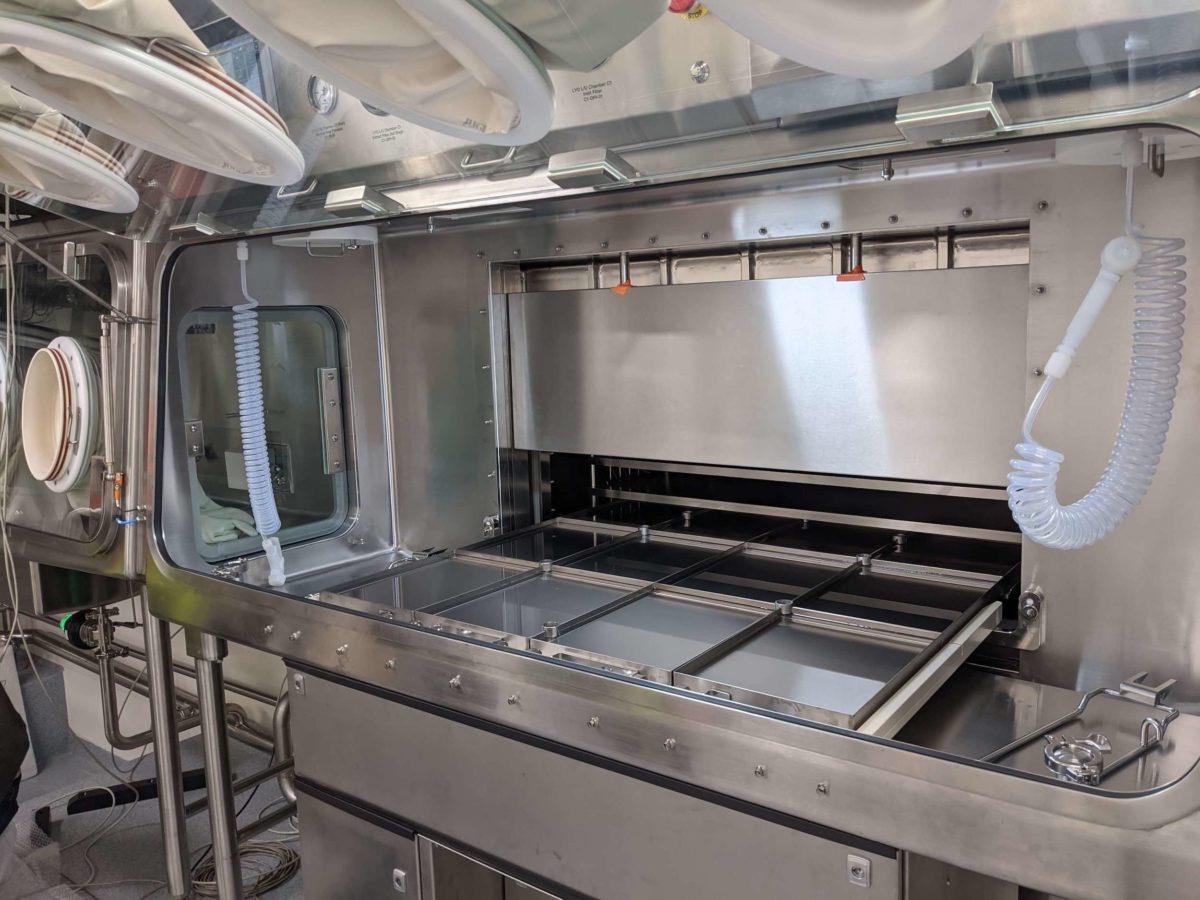 One of the loading systems we engineered and built.
 2. Privacy and data security
The increasing use of data analysis, AI, and other advanced technologies provides enormous quantities of data. Maintaining data privacy and security is a major challenge, as the data is often sensitive and subject to regulatory oversight.
Our advice: work together with a machine developer that can cover every possible safety topic, on both a machine and software level, mechanically and from a programming perspective.
3. Integration of legacy systems
Some pharmaceutical companies still rely on legacy or antiquated systems that are often incompatible with new digital technologies. Integration calls for careful planning and implementation.
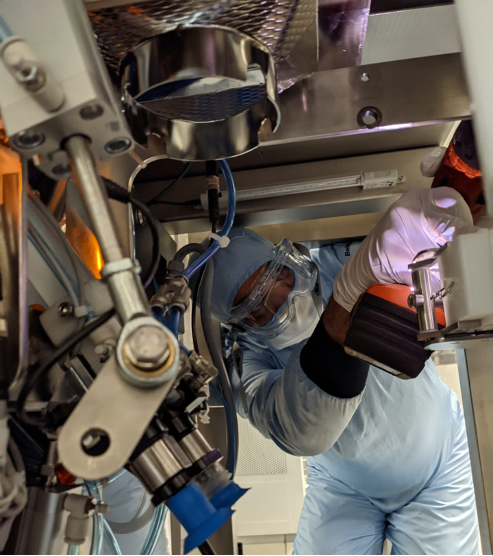
It is crucial to partner with a full-service machine developer who can offer a broader perspective on your pharmaceutical manufacturing. We develop and build high-tech custom machinery, but we also retrofit existing machines into state-of-the-art production equipment. This ensures we have the expertise in every possible aspect of machine development.
As for the integration of new technologies in existing machinery: rest assured we will maximize the value of your business case. We analyze your machines from every angle—software, mechanics, electrical, and digital—as well as from the perspective of maintenance and spare parts management.
Two cases that put this theory in practice, both retrofits of a packaging machine:
4. Recruiting and retaining talent
The pharmaceutical manufacturing processes of tomorrow require a new skill set, including data analytics, AI, and machine learning. Having the right skills on board is essential.
That said, the real challenge for us as a machine developer is to make the machine itself very intuitive to operate. The right technology makes your machinery more accessible. Increased accessibility means being less dependent on specialized operators, to the point where even non-technical staff can operate them effectively.
We elaborate on this topic in the article Operator-indepent machines as an answer to the tight labor market.
5. The investment
Integrating these technologies requires a considerable investment in infrastructure, software, and talent. This is not something to be taken for granted, especially for smaller pharmaceutical companies.
ROI is crucial in any business case. The numbers for a new machine or a retrofit must add up. In practice, we notice that companies often underestimate ROI, leading to inaccurate business cases and a greater risk of poor decision-making.
Our advice: look at the whole picture. ROI is about more than just increased output or better product quality.
Financially, ROI aligns with CAPEX budgets. These expenditures are typically managed by project managers.
ROI is too narrow
However, when making decisions about machinery investments, ROI is often too narrow a metric. A significant portion of the total costs is actually related to the ongoing operation of the system. Therefore, it is crucial to gain insight into the total costs over the machine’s entire lifespan from the very beginning: the TCO.
An investment can be profitable in its own right if it reduces current operating costs. TCO is the sum of both CAPEX and OPEX budgets; as such, it represents the full budget required to substantiate a business case. Allocating sufficient time and attention to gain a well-founded understanding of OPEX budgets can significantly reduce the overall cost over the machine’s lifetime.
The iceberg metaphor (see below) clearly illustrates that a significant portion of a machine’s cost of ownership is driven by hidden costs. Determining the TCO naturally depends heavily on the choices made. Here are some tips and tricks to get you started:
1/The most visible costs (The major components)
- Electrical cabinets and wiring.
- Hardware (motors, drives, robots, etc.).
- Mechanical components.
2/ The most underrated costs (Labor hours)
- Project Management: Calculations, project follow-up, safety planning, and aftercare.
- Engineering Hours: Research, measurement, design, detailing, consultation, and documentation.
- Assembly & Commissioning: Installation, startup, validation, and decommissioning of old systems.
- Software: Specifications, offline and online testing, documentation, and training.
3. The returns (Expected savings & potential revenue)
- Reduction in labor-related costs: Including wages, benefits, insurance, and personnel-related infrastructure.
- Increased reliability and capacity.
- Elimination of human variables: Such as work interruptions, shortages of skilled labor, and absenteeism.
- Efficiency gains: The ability to increase production while reducing physical floor space, energy consumption, and raw material requirements.
- Reduced downtime and training: Achieved through highly intuitive Human-Machine Interface (HMI) solutions.
- 24/7 Operational potential: Continuous operation with minimal, predictable downtime for maintenance.
- Digitalization benefits: Various gains and advantages resulting from advanced digitalization.

6. Protection of intellectual property
As the use of digital technologies in pharmaceutical manufacturing increases, so does the concern for the protection of intellectual property (IP).
Protecting IP correctly takes time and attention. Patent applications can be submitted for AI algorithms or specific hardware components. Copyright can also be applied to the output.
As a machine developer, we help secure the intellectual property within your company to strengthen your competitive position. We do so with full transparency, which is quite uncommon in this industry.
As a developer, we offer the complete technical construction file of the machine. This means that not only the machine is yours, but also the entire package of intellectual property related to its development. This way, you are 100% certain that your customized machine is completely yours.
The first step
So tell us, which challenge are you looking to face head-on?